


2025 was a year defined by rapid change. Economic pressures, rising customer expectations, and accelerated digital transformation pushed organizations across industries to rethink how they connect with the people they serve.
Utilities faced affordability challenges and electrification shifts, while financial institutions, including credit unions and banks, experienced intense competition, margin pressure, rising expectations for digital-first experiences and an urgent need to personalize member/customer engagement.
Across both industries, one theme stood out: organizations that leveraged data-driven decision making consistently outperformed their peers.
And that’s exactly where BlastPoint made its impact, helping teams turn raw data into precise, actionable intelligence that drives measurable outcomes.
As we close out the year, here’s a look at what happened in 2025, the insights we gained, what we built, and what we believe 2026 will bring.
2025 in Review: Cross-Industry Shifts That Defined the Year
AI Became a Must-Have, Not a Nice-to-Have
Across utilities and financial institutions, organizations moved rapidly from analytics experiments to full-scale operational use cases. Teams needed faster insights, stronger predictions, and clearer guidance about what to do next. AI adoption grew because it solved real, day-to-day problems, delinquency prevention, customer retention, product adoption, and awareness building.
Data Quality Finally Took Center Stage
2025 proved that no amount of AI matters without trustworthy data. Many organizations confronted long-standing data gaps, missing contact data, outdated records, siloed systems, and turned to BlastPoint to validate, enrich, and unify data for more reliable decision-making.
Engagement Became “Always On”
Rather than relying on large, episodic campaigns, both utilities and FIs embraced continuous micro-engagement, triggered by propensity scores, risk signals, and changes in customer behavior. Whether identifying at-risk households or recognizing customers likely to open a new product, personalization delivered measurable ROI.
What We Saw in Utilities: 2025 Highlights
2025 brought significant challenges for utilities, such as rising affordability concerns, evolving regulatory expectations, changing customer behavior from electrification and EV adoption, and new economic pressures affecting vulnerable households. Uncertainty around LIHEAP funding and a prolonged government shutdown further strained customers who rely on federal support, leaving many at elevated risk of missed payments and growing arrearages.
Facing LIHEAP Uncertainty with Action
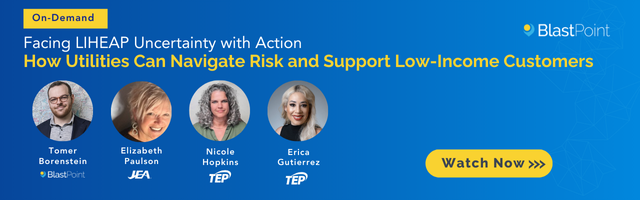
BlastPoint released a focused LIHEAP Webinar to help utilities navigate funding uncertainty, forecast demand, and strengthen outreach to eligible households during a year of shifting federal guidance.
Government Shutdown Resource Hub

To support customers affected by missed paychecks and delayed benefits, BlastPoint has compiled actionable data, financial relief programs, and communication resources to help utilities support these households before the crisis deepens.
Here’s how utilities responded with the help of BlastPoint:
1. Proactive Affordability & Delinquency Prevention
Utilities used predictive models to identify households at risk of first-time delinquency weeks before it occurred, enabling timely interventions like payment reminders, customized plans, or targeted assistance outreach.
White Paper:Predicting and Preventing Delinquencies for Utilities

Learn how leading utilities are using AI-powered insights to lower delinquency rates, recover revenue, and improve customer relationships.
Download the white paper today and learn how you can reduce first-time late payments before they happen!
2. Smarter Program Targeting
Utilities leveraged segmentation models to target customers most likely to benefit from:
- Assistance programs
- Energy efficiency initiatives
- Paperless billing or digital tools
3. Digital Experience Acceleration
Utilities deployed micro-targeting to drive greater adoption of digital services, such as payment portals, mobile apps, and self-service channels, improving customer satisfaction and reducing operational costs.
2026 Outlook for Utilities: What to Expect
Utilities are poised for even deeper transformation. We expect 2026 to be the year when predictive insights become foundational to operations.
Key Predictions
1. Predictive + Preventive Operations Become Standard Practice
Delinquency forecasting and affordability scoring will evolve from “innovative” to “essential.” Customer care teams will rely on early warning signals to act before challenges escalate.
2. Electrification & EV Forecasting Become Critical
Utilities will increasingly rely on AI to anticipate EV adoption, identify DER opportunities, and inform load shaping and infrastructure planning.
3. Equity, Transparency, and Measurable Impact Rise in Importance
Regulatory bodies will expect clear evidence that utilities are using data-driven strategies to ensure equitable program access and measurable customer benefit.
How Utilities Can Prepare for 2026
- Strengthen data foundations, especially contact and household insights
- Design proactive affordability and delinquency strategies
- Prepare for transparent, measurable program targeting
What We Saw in Financial Institutions: 2025 Highlights
Financial institutions, including credit unions and community/retail banks, navigated a year of tight margins, regulatory scrutiny, and heightened consumer expectations. The winners were those that used data to build deeper member/customer relationships and act decisively.
1. AI Moved from Pilot Projects to Daily Operations
FIs dramatically increased use of predictive models for:
- Customer/member churn & retention
- Loan cross-sell, refinance, & pre-qualification
- Delinquency and risk management
- CD, deposit, and product adoption propensity
These insights became part of everyday workflows for lending, marketing, digital channels, and member/customer experience.
2. Retention & Relationship Deepening Took Center Stage
With increasing competition from fintechs and digital-first banks, FIs focused on:
- Preventing silent attrition
- Increasing share of wallet
- Recognizing life-stage and behavioral triggers to deliver relevant offers
3. Data Governance Became a Competitive Advantage
As financial institutions prepared for broader AI adoption, investment in data governance, model oversight, and quality controls accelerated.
White Paper: AI and Data Governance

This whitepaper demystifies artificial intelligence and data governance, offering actionable insights on how credit unions can responsibly implement AI to drive member growth, operational efficiency, and regulatory compliance.
White Paper: The Essential Guide to External Data

This white paper explains how financial institutions can drive growth by leveraging external data for more targeted strategies, improved customer experiences, and stronger market positioning. By integrating public and vendor data sources, institutions can accelerate deposit growth, deepen engagement, and reach high-value segments with greater precision.
2026 Outlook for Financial Institutions: What to Expect
The coming year will reshape how banks and credit unions use intelligence to compete, retain customers/members, and grow relationships.
Key Predictions
1. AI-Powered Personalization Becomes the Default Customer/Member Expectation
Customers/Members will expect tailored experiences across mobile, online, and in-branch channels. FIs using predictive intelligence will outperform in cross-sell, retention, and service.
2. Lending Becomes More Intelligent, Inclusive, and Predictive
Institutions will increasingly incorporate external data and behavioral indicators to:
- Improve decisioning
- Expand access responsibly
- Identify early signs of delinquency
- Support fair and compliant outcomes
White Paper: Predicting and Preventing Delinquencies for Credit Union
Delinquency is rising, especially among first-time late payers who often go unnoticed until it’s too late. BlastPoint’s Customer Intelligence Platform helps credit unions predict risk early and engage members with AI-driven insights and personalized outreach, reducing delinquency and recovering revenue.
Download our white paper to see how your team can prevent first-time late payments before they happen!
3. Explainable AI & Governance Become Mandatory
From boards to regulators, stakeholders will expect transparency, auditability, and evidence-based decision-making.
How FIs Can Prepare for 2026
- Build a clear AI roadmap tied to retention and growth goals
- Invest in data governance and quality frameworks
- Deploy always-on models for churn, product propensity, and risk
Strengthening Engagement and Resilience in 2026
2025 made one thing clear: organizations that use data-driven insight to guide engagement, strengthen operations, and support vulnerable communities are better equipped to navigate uncertainty. Utilities and financial institutions that embraced predictive approaches saw measurable improvements in outreach effectiveness, affordability strategies, and customer or member satisfaction.
As we move into 2026, a single truth stands out: organizations that understand the people they serve and act with clarity and consistency will lead the way. Whether the goal is reducing arrearages, improving member relationships, or planning for electrification, data-powered decision-making will continue to drive meaningful impact.
At BlastPoint, we’re committed to helping our partners turn insight into action. Here’s to another year of progress, resilience, and innovation together.
From everyone at BlastPoint, Merry Christmas and Happy New Year!