
How your peer benchmark position impacts rate strategy, regulatory exposure, and capital planning
Utilities across the country are navigating a collision of forces: rate increases driven by grid modernization, clean energy mandates, wildfire mitigation, and infrastructure replacement — all landing on customers who are already financially stretched.
Yet until now, there has been no standardized, peer-relative way to compare affordability pressure across utilities.
Affordability is becoming a structural constraint in utility strategy. Not in theory. In measurable ways.
To bring clarity to the issue, BlastPoint analyzed 1,199 U.S. investor-owned and municipal utilities to measure customer affordability pressure and to benchmark how each utility ranks within its true peer group.
Why This Benchmark Matters to You
Utilities with high rates serving financially constrained customers face greater regulatory and financial risk. This benchmark shows where you stand relative to peers and what that position signals strategically.
If you oversee rate strategy or regulatory affairs:
Affordability pressure directly shapes rate case outcomes. Higher-ranked utilities face longer approvals, tougher scrutiny, and less tolerance for increases.
If you lead customer operations:
Affordability is a leading indicator of call volume, delinquencies, and assistance program strain. Your ranking quantifies that exposure relative to peers.
If you oversee financial performance:
Bad debt, uncollectibles, and revenue risk concentrate in high-pressure territories. Your position signals both current exposure and capital pacing flexibility.
If you lead capital planning:
Rate recovery funds infrastructure. Affordability pressure limits headroom for long-term investment.
The issue isn’t whether affordability matters.
It’s whether you know how your utility compares before regulators or headlines define the narrative for you.
Want to see where your utility stands today? Explore your PressurePoint benchmark and peer position.
How the Benchmark Works
The PressurePoint Score is calculated using publicly available data from the U.S. Energy Information Administration (EIA) and U.S. Census Bureau American Community Survey (ACS).
The formula:
PressurePoint Score = Electricity Rate (¢/kWh) × Poverty Rate (%)
This captures the structural interaction between energy cost and customer economic vulnerability.
Utilities are graded within their cohort using four tiers:
Most Exposed (Top 20%) | At Risk (60th–80th percentile) | Watch List (40th–60th percentile) | Defensible (Bottom 40%)
The Framework: Six Peer Cohorts
BlastPoint conducted a national affordability analysis across 1,199 investor-owned and municipal utilities, revealing where structural customer pressure is building and how utilities compare within their peer groups.
Utilities were grouped by ownership and customer count:
Investor-Owned Utilities
- Megawatt Majors (500,000+ residential customers — 56 utilities)
- Regional Powerhouses (100,000–500,000 — 48 utilities)
- Frontier Operators (Under 100,000 — 40 utilities)
Municipal Utilities
- Metro Municipals (100,000+ — 19 utilities)
- Community Anchors (25,000–99,999 — 80 utilities)
- Local Providers (Under 25,000 — 359 utilities)
In this blog, we share high-level insights by cohort, not individual utility rankings.
Each utility receives one of four tier grades — Most Exposed, At Risk, Watch List, or Defensible — within its cohort based on affordability pressure.
The cohort charts displayed here are intentionally blurred. They illustrate overall distribution, not public ranking. PressurePoint is a confidential executive benchmark, and individual utility positions are not published.
To view the full, unblurred cohort comparison and see exactly where your utility ranks, visit: https://pressurepoint.blastpoint.com/
Key Insights: National Snapshot: Where Pressure Is Concentrated
Analysis of the 1,199 utilities in the PressurePoint index reveals:
- More than 25 million U.S. residential electricity customers — nearly one in four IOU and municipal customers in the dataset — are served by utilities flagged Most Exposed for affordability pressure within their peer group.
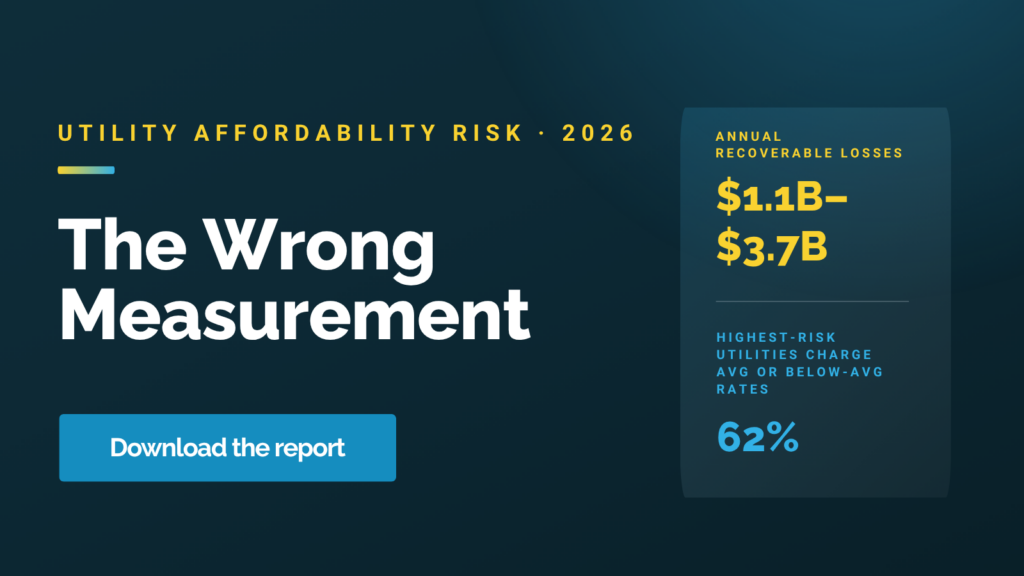
- 62% of Most Exposed utilities charge residential rates at or below the U.S average. Utilities like Fulton Electric System in Kentucky (rate 13.6¢/kWh, 32% poverty) and Albany Utility Board in Georgia (rate 12.9¢/kWh, 30% poverty) score in the Most Exposed tier despite below-average rates.
- Investor-owned utilities carry 18% higher affordability pressure on average than municipalities (PressurePoint score of 2.06 vs. 1.75), reflecting their meaningfully higher effective rate structures.
- 80+ utilities have seen rate increases exceeding 30% over the past five years, collectively serving more than 43 million customers. The steepest five-year increases are all in California: Liberty Utilities California (+93%), Moreno Valley Electric Utility (+88%), and Southern California Edison (+86%).
- Affordability pressure is not just a large-utility problem. Small municipal providers like Hickman Electric System, KY (rank 4 of 359 in its cohort) and Lumberton Municipal Electric, NC (rank 9 of 359) score in the Most Exposed tier, proving the squeeze hits communities of every size.
Investor-Owned Utilities
Megawatt Majors (500K+ Customers)
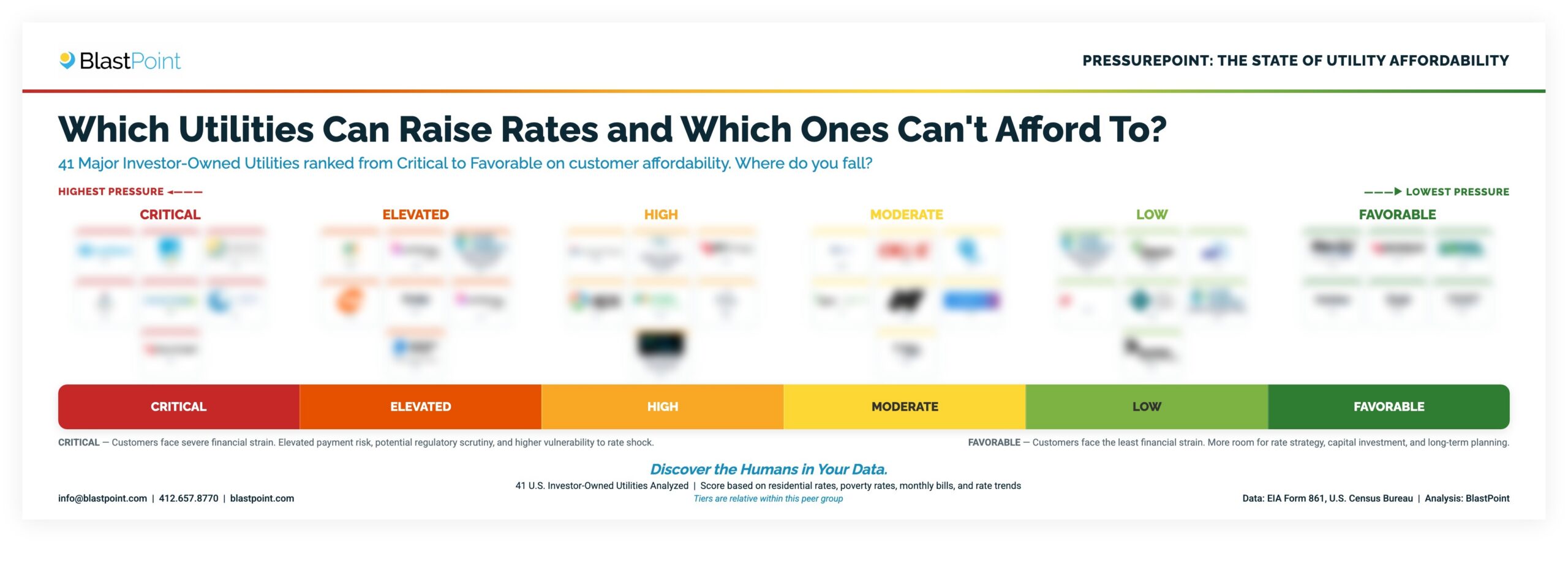
In the largest IOUs, affordability pressure is amplified by rate trajectory.
- Several Most Exposed systems collectively serve millions of customers under severe strain
- One utility in this cohort (Southern California Edison) increased rates +86% in five years, the most dramatic jump among large IOUs
- 55 IOUs in the broader dataset have seen >30% five-year increases
For the largest systems, affordability grade directly correlates with rate case risk. A Most Exposed or At Risk position means future filings will face measurable headwinds, politically and regulatorily.
Regional Powerhouses (100K–500K Customers)
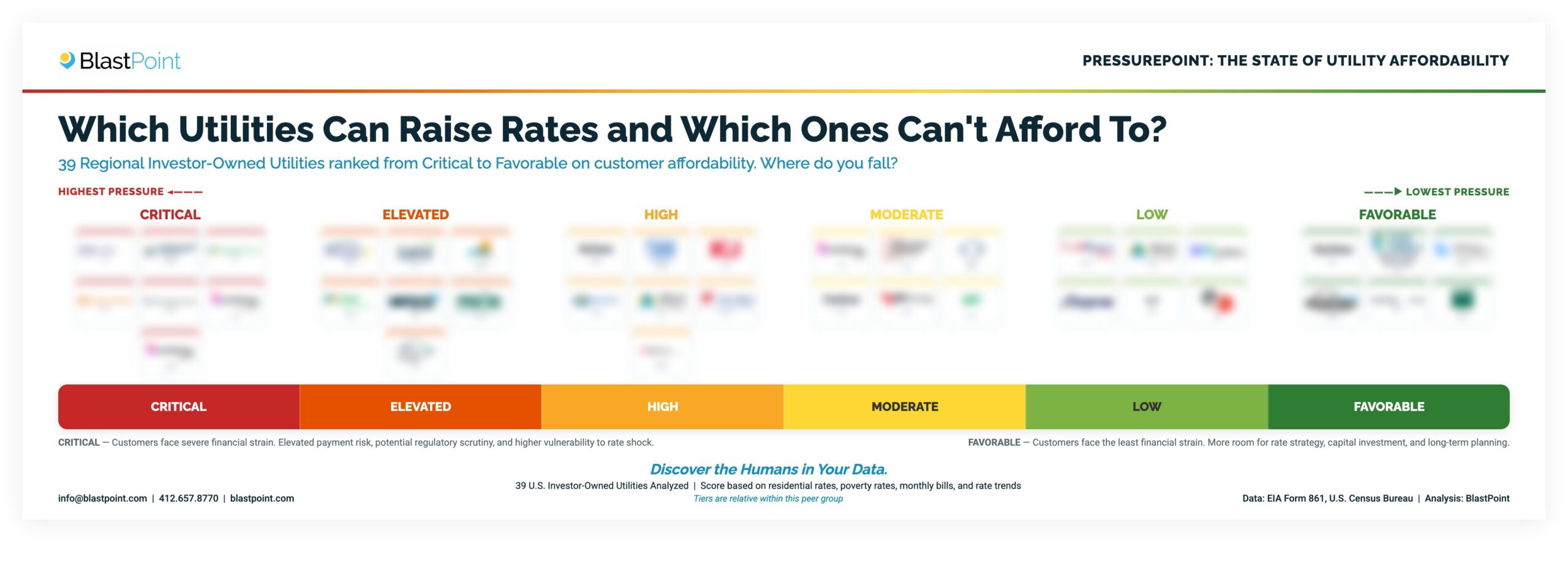
This cohort is the most volatile.
- Island-based and economically concentrated territories dominate the highest-pressure positions
- One regional IOU (Versant Power, ME) increased rates +47% in five years — the steepest in this cohort
- Pressure often surfaces here before it becomes visible in larger systems
Mid-sized IOUs operating in economically mixed territories are highly sensitive. A single high-poverty county can materially shift cohort position.
Frontier Operators (Under 100K Customers)
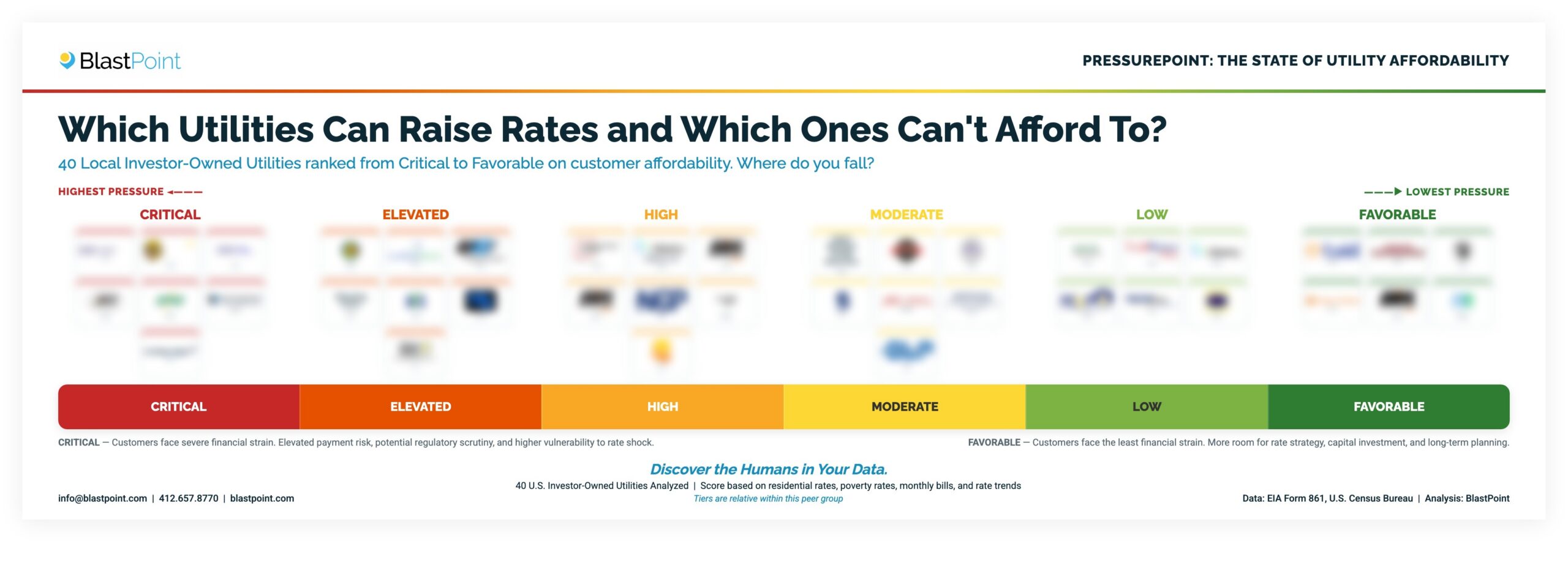
Scale does not protect smaller IOUs.
- High poverty exposure, even with moderate rates, pushes several into the At Risk tier
- Low-ranked systems often benefit from stable local economies, not different strategy
For small IOUs, even modest rate adjustments can shift your grade. Affordability is not a large-utility issue. It is structural and demographic.
Municipal Utilities
Metro Municipals (100K+ Customers)
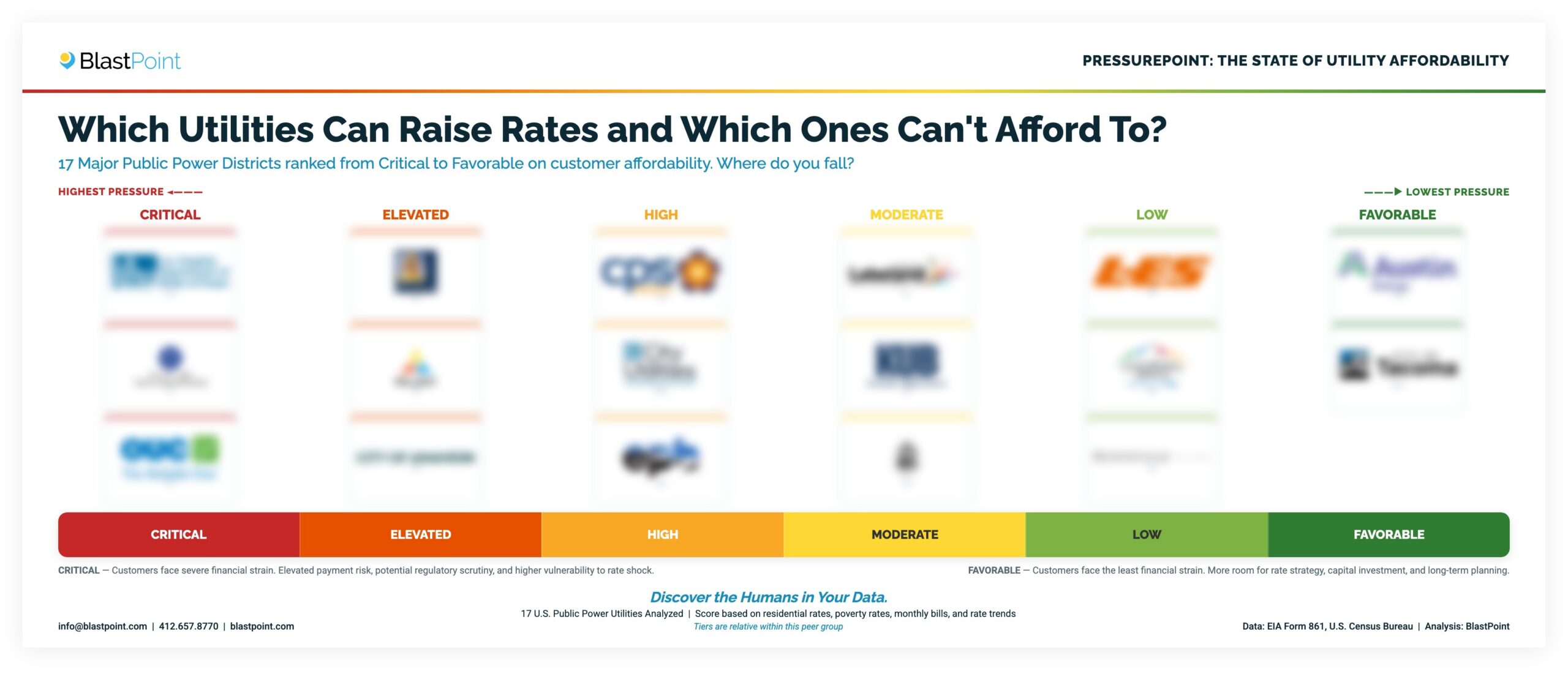
Large municipals benefit from rate governance stability but poverty concentration dominates outcomes.
- The highest-pressure system in this cohort combines the highest muni rate structure with double-digit poverty
- No Metro Municipal has raised rates >30% in five years
For large munis, poverty exposure, not rate volatility, drives pressure. Rate stability alone does not insulate affordability risk.
Community Anchors (25K–100K Customers)
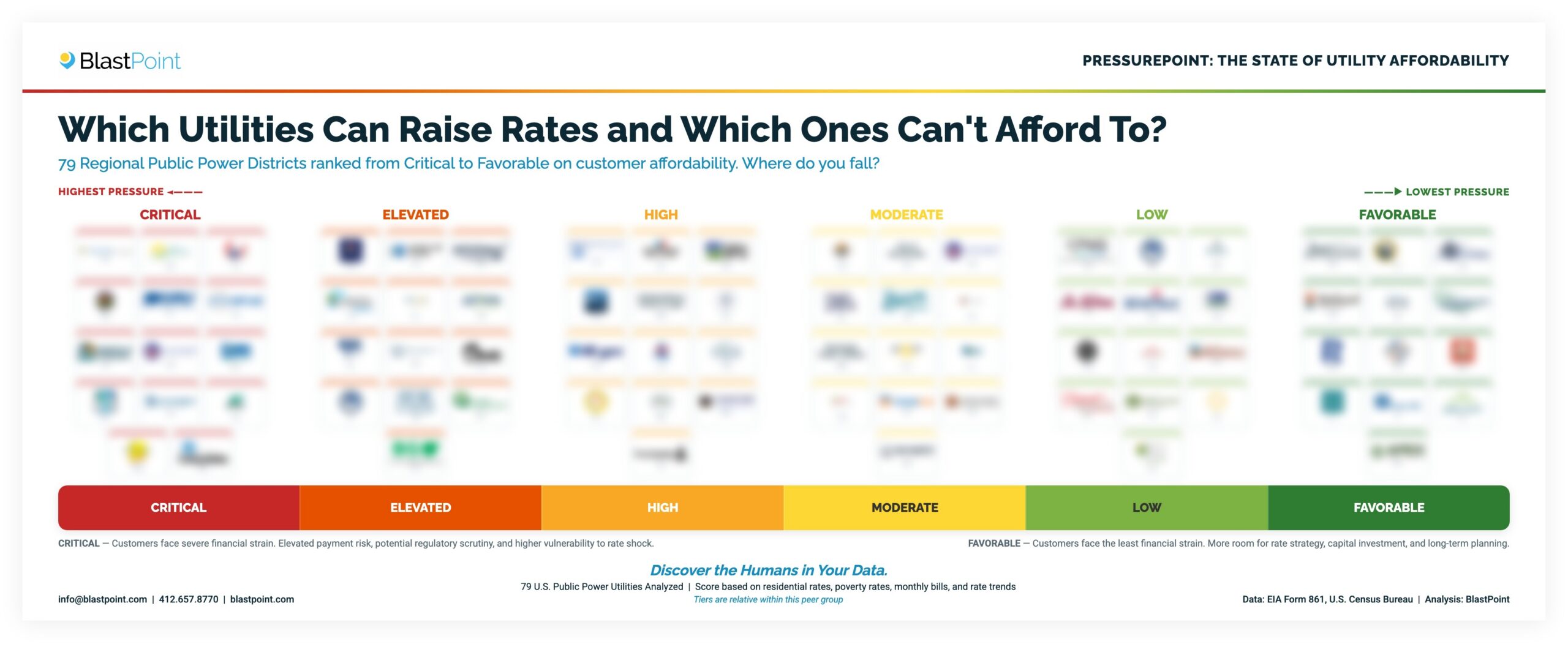
The most diverse cohort.
- Poverty ranges from single digits to 20%+
- College towns and Southern/Southwestern systems show compound exposure: poverty + rising rates + weather-driven usage
- One utility (Glendale Water & Power, CA) recorded a +69% five-year rate increase, highest in this group
Community Anchors face compound risk: economic vulnerability layered with upward rate trajectory and climate-driven consumption.
Local Providers (Under 25K Customers)
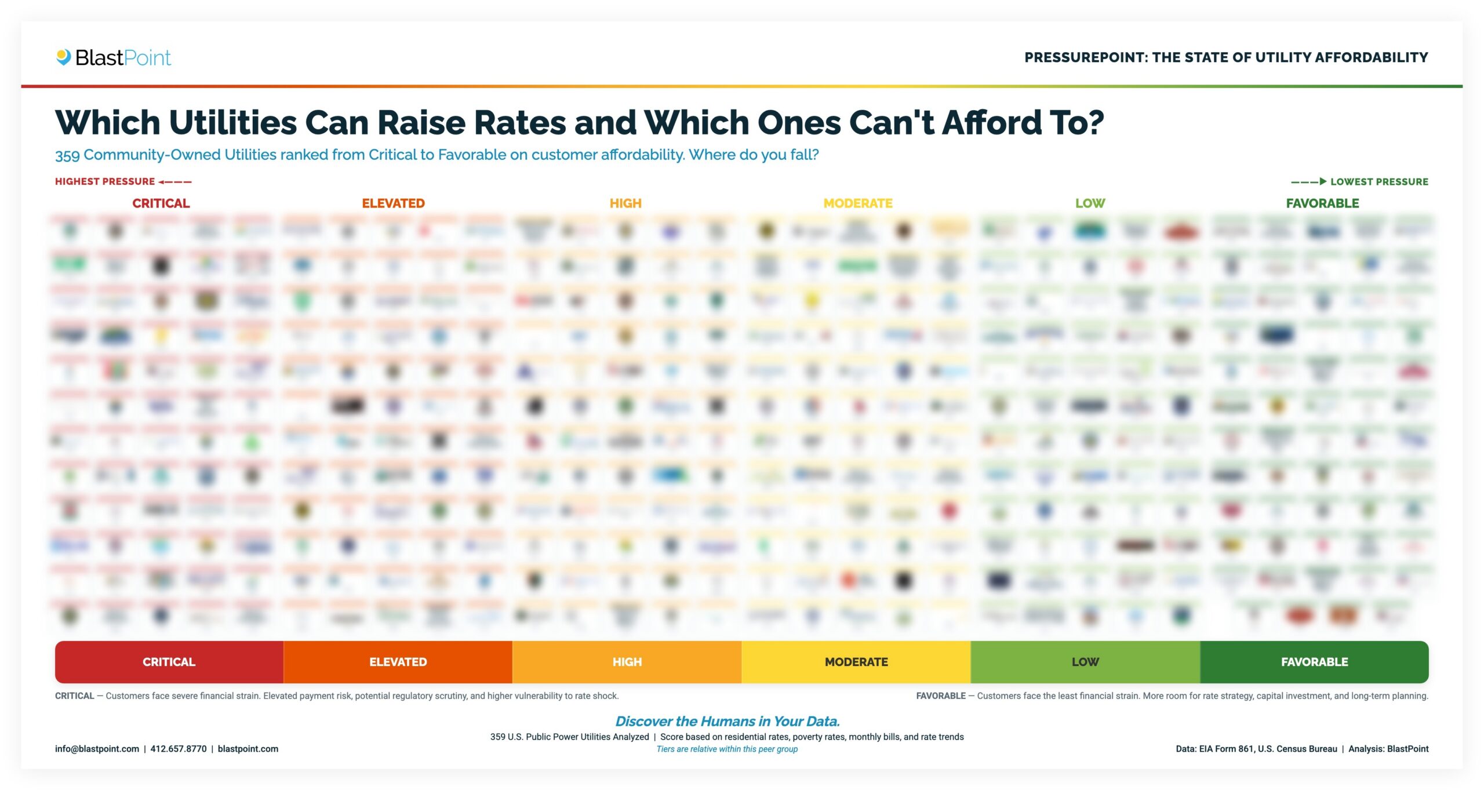
The largest cohort by count and often the least visible.
- Several Most Exposed systems are driven almost entirely by poverty concentration (26–29%)
- One outlier’s pressure is rate-structure driven rather than demographic
For small municipals, affordability is overwhelmingly demographic. The strategic lever is targeted assistance enrollment and customer analytics, not simply rate suppression.
What Cohort Ranking Signals for Leadership
A Most Exposed or At Risk grade within your peer group signals:
- Increased arrears exposure
- Heightened rate sensitivity
- Greater regulatory scrutiny during adjustments
- Reduced long-term capital pacing flexibility
Conversely, lower-tier rankings suggest stronger strategic optionality.
Peer-relative position reframes affordability from a general social issue into a competitive and regulatory positioning metric.
Where Does Your Utility Rank?
Every utility has a defined position within its cohort, and that position carries strategic implications.
In a private review, we share the unblurred cohort view, your exact placement, and the structural drivers behind your tier.
In a confidential review, we examine:
- Your exact PressurePoint tier and peer percentile
- Your average bill relative to cohort benchmarks
- Poverty exposure compared to state and regional norms
- The primary structural driver of your affordability pressure
- How your recent rate trajectory affects forward risk
We translate that position into what it means for regulatory posture, capital planning flexibility, and rate strategy.
If you would like a confidential review of where your utility stands and what it signals strategically, visit PressurePoint and explore your results and peer benchmark.
Last updated July 29, 2026.