
Utility leaders are under pressure to improve customer satisfaction, increase program adoption, and demonstrate measurable impact without expanding teams or budgets.
Yet most outreach strategies still rely on static demographic segmentation and campaign calendars. The result is predictable: generic messaging, outreach fatigue, and limited visibility into what actually drives behavior change.
The issue isn’t data scarcity. Utilities have more data than ever. The challenge is turning that data into clear, actionable signals that guide outreach decisions at scale.
Why Traditional Segmentation Falls Short
Demographics explain who a customer is. They rarely explain what that customer needs right now.
Two households in the same ZIP code with similar income levels may have entirely different experiences:
- One may be researching electrification options.
- The other may be frustrated by repeated outages.
Sending both the same message erodes relevance and over time, trust.
As volume increases, effectiveness declines. And when communication feels reactive rather than proactive, CSAT suffers.
The Shift: From Campaign-Driven to Signal-Driven
High-performing utilities are moving toward signal-driven engagement.
Instead of building broad campaigns first and then finding audiences, they start with outcomes:
- Improve CSAT
- Increase program adoption
- Reduce reliability-related complaints
- Mitigate arrears risk
Then they identify early signals that indicate which customers are most impacted, most ready, or most at risk.
Signals can include:
- Outage history
- Usage pattern shifts
- Engagement trends
- Call center interactions
- Program participation history
This approach narrows focus to high-impact micro-segments, allowing utilities to reduce outreach volume while increasing relevance.
How BlastPoint Enables Hyper-Personalized Outreach
In regulated environments, the combination of improved customer experience and operational efficiency is especially powerful. Utilities must deliver measurable results while maintaining transparency, defensibility, and trust.
BlastPoint enables utilities to operationalize hyper-personalized outreach by transforming fragmented customer data into unified intelligence and explainable AI-driven action.
From Raw Data to Actionable Signals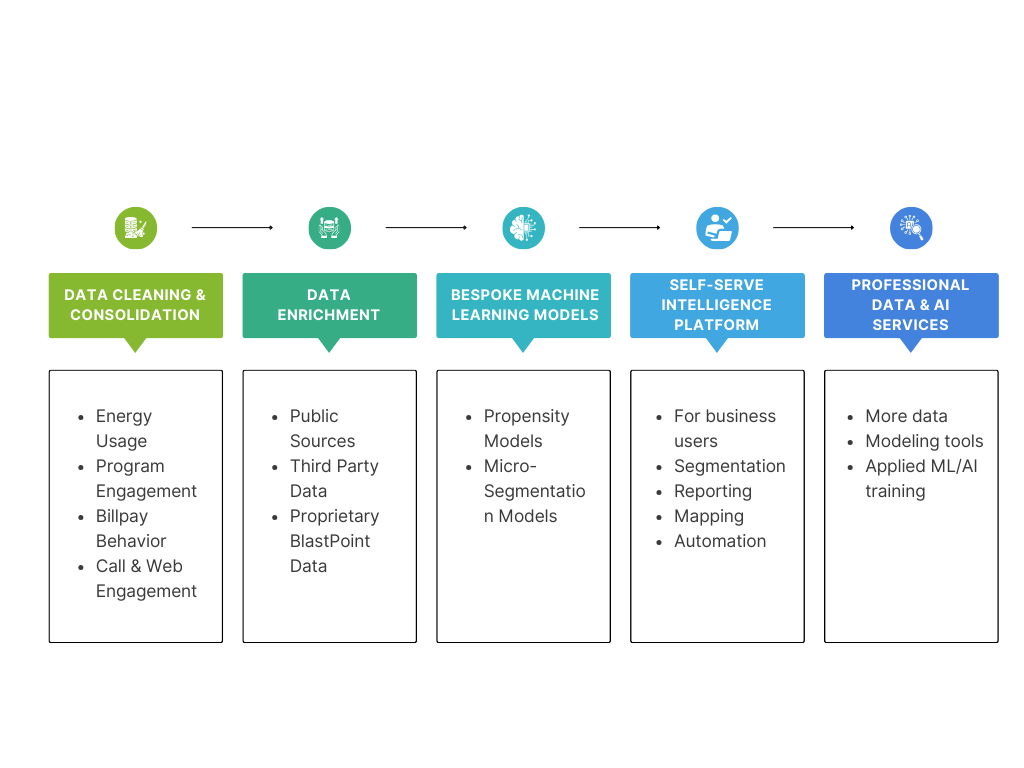
BlastPoint doesn’t just layer data—it operationalizes it.
We securely ingest and consolidate utility data across billing, usage, program participation, and engagement systems. That data is then enriched with third-party and public sources, standardized, and aggregated to create a unified household-level view
On top of this foundation, BlastPoint builds bespoke machine learning models, such as propensity and predictive CSAT models that score an entire audience based on likelihood to adopt, churn, enroll, or shift sentiment
This gives utilities more than segments. It gives prioritized clarity.
Layered Segmentation for Precision
BlastPoint models assign scores across the full audience. From there, utilities can layer:
- Program-specific enrollment status
- Channel and communication preferences
- Geographic and infrastructure proximity
- Behavioral and engagement signals
This layered segmentation approach makes each model more powerful and ensures that outreach aligns with both intent and context
Instead of broad campaigns, utilities create high-impact micro-segments tied directly to business goals.
Insight to Action — In One Platform
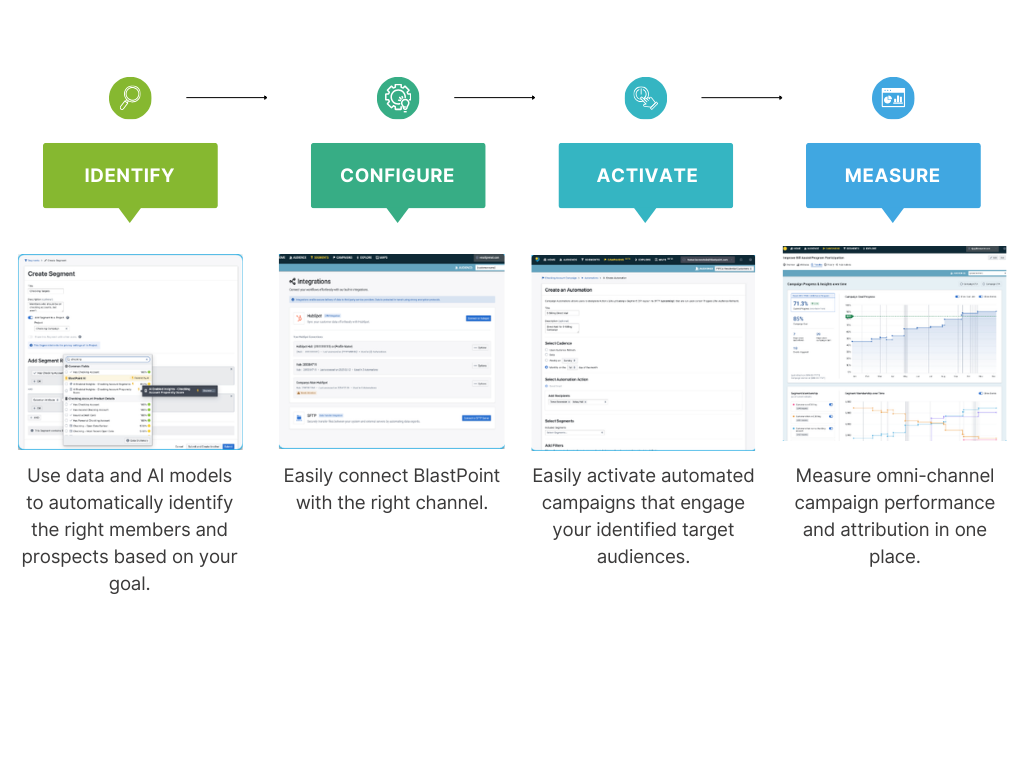
BlastPoint enables business users to:
- Build and export prioritized segments
- Visualize geographic concentration through mapping tools
- Trigger automated outreach based on dynamic rules
- Track campaign performance directly against KPIs and CSAT goals
Everything lives in one intelligence layer—models, segments, campaigns, and measurement.
Case in Point: 12.7% CSAT Increase Before Construction Was Complete
An electric service company used predictive CSAT modeling and targeted segmentation to proactively communicate a substation upgrade to customers most impacted by reliability issues.
By engaging this micro-segment before and during construction, the utility achieved a 12.7% increase in CSAT in less than two months—representing 30% progress toward its 1-point improvement goal—before the project was even completed.
Download the full case study to see how the strategy was implemented.
What This Means for Utility Leaders
The takeaway isn’t that utilities need more campaigns. It’s that they need sharper focus.
When outreach is guided by clear outcomes and meaningful signals, teams stop spreading effort across broad audiences and start prioritizing customers where engagement will have measurable impact.
That shift delivers tangible results:
- Higher program adoption
- Improved CSAT
- Fewer reliability-related complaints
- Reduced operational strain
- Greater regulatory confidence
Most importantly, it allows utilities to drive performance improvements without increasing headcount or communication volume.
The Bottom Line
Utilities don’t lack data. They lack prioritization clarity.
Hyper-personalized, signal-driven outreach transforms existing data into actionable intelligence, helping leaders move from reactive communication to proactive engagement.
The result is measurable impact: stronger adoption, improved satisfaction, and deeper customer trust.
In today’s regulatory and economic environment, that’s not simply a communications upgrade, it’s a strategic advantage.
If you’re ready to see how signal-driven segmentation and predictive CSAT modeling can work within your utility, schedule a demo with BlastPoint to explore how you can drive measurable impact without adding headcount.